
One thing we’ve learnt during our own IVF journeys is that there are very few decisions in fertility treatment that have a simple right or wrong answer.
One of those decisions is when an embryo should be transferred.
From what we’ve read, allowing embryos to develop until Day 5 gives embryologists more time to see which embryos continue growing. Embryos that reach the blastocyst stage are generally more likely to implant, and previous research has shown improved live birth rates per fresh transfer for many patients – particularly those with several embryos available. This is one of the reasons Day 5 transfers have become so common in IVF.
When we both started IVF treatment in Denmark, we were only ever offered Day 2 or Day 3 embryo transfers. Like many, we always hoped our embryos would make it to Day 5. To us, reaching the blastocyst stage felt like another milestone. When our embryos were transferred on Day 2 or Day 3, it was hard not to feel like we’d fallen short. In our minds, making it to Day 5 had somehow become the goal.
Why This Study Resonated With Us
During that stage of our individual journeys, none of Alex’s embryos – and only one of Ali’s – ever made it to blastocyst. At the time, it was difficult not to wonder why our embryos hadn’t made it further.
But waiting until Day 5 isn’t without its own risks.
On another cycle, Ali and her new doctor decided to wait until Day 5 rather than transferring on Day 3. This time, none of the embryos continued developing, and there was no embryo left to transfer. It felt devastating.
Looking back, we realise we never really understood why some embryos were transferred earlier while others were left to develop for longer.
We were often told that once an embryo was back in the womb, it would probably have the best chance of continuing to develop. At the time, we didn’t think much more about it – it simply made sense.
Then we came across a newly published study looking specifically at patients with only one fertilised egg, and it really caught our attention.
Understanding that there may be different approaches for patients with only one fertilised egg would have helped us make a little more sense of our own journeys – and reminded us that not making it to Day 5 wasn’t necessarily something we’d done wrong, It asked a question we’d never really considered before:
Could transferring earlier actually be the better option for some people?
We were curious, so we took a closer look. Here’s what we found.

Understanding the Research
Before looking at the study itself, let’s look at what happens during embryo development.
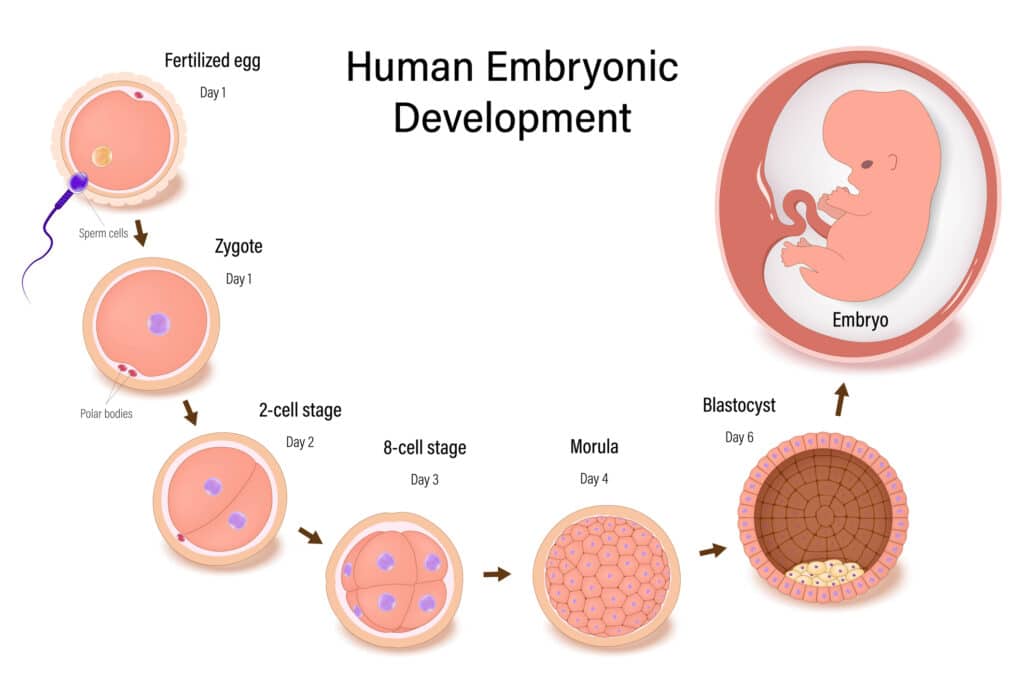
After an egg is fertilised, it begins dividing into more cells. By Day 3, it’s usually made up of around six to eight cells and is known as a cleavage-stage embryo. By Day 5 or 6, embryos that continue developing may reach what’s known as the blastocyst stage, where they’re preparing for implantation.
Many IVF clinics now routinely culture embryos until this stage before transferring or freezing them, particularly for patients with several embryos available.
But that’s not the situation this study looked at.
So What Happens If There’s Only One Fertilised Egg?
If there’s only one fertilised egg, waiting until Day 5 introduces another possibility. The embryo may stop developing before it reaches the blastocyst stage.
If that happens, there may be no embryo available to transfer at all – as happened during one of Ali’s cycles.
After everything that comes before – stimulation, egg collection, fertilisation, and all the waiting – that’s an incredibly difficult possibility.
So…What Did The Study Find?
The study analysed more than 11,000 IVF cycles involving patients who had only one normally fertilised egg.
The researchers compared patients who had:
- A Day 3 embryo transfer, and
- A Day 5 blastocyst transfer.
After taking other patient factors into account, they found that Day 3 transfers were associated with higher live birth rates in this specific group.
Interestingly, this difference became more noticeable with increasing maternal age.
The researchers suggested that embryos from older patients may be more likely to stop developing before reaching the blastocyst stage, increasing the chance that there would be no embryo left to transfer.
Does This Mean Day 3 Is Better?
From what we understood, this study isn’t saying that everyone should have a Day 3 transfer. It also doesn’t prove that embryos develop better inside the uterus than they do in the laboratory.
What it does seem to suggest is that patients with only one fertilised egg may need to be looked at a little differently from patients who have several embryos available.
Most of the previous research supporting Day 5 transfers involved people with multiple embryos to choose from. This study looked at a much more specific group, raising the possibility that the balance of risks and benefits may be different when there’s only one fertilised egg.
A Few Things To Keep In Mind
One thing we’ve learnt from reading fertility research is that one study rarely changes everything.
Although this study included more than 11,000 IVF cycles, it was what’s known as a retrospective observational study, meaning the researchers looked back at treatments that had already happened rather than randomly assigning patients to a Day 3 or Day 5 transfer.
Studies like this are really valuable because they help identify patterns and raise important questions. But on their own, they can’t tell us with certainty that one approach caused the results.
It’ll be really interesting to see whether future studies find similar results, and whether this research eventually influences IVF treatment.
Final Thoughts
This study reminded us that IVF is rarely one-size-fits-all.
When we were going through treatment, we never really questioned why our embryos were transferred on Day 2 or Day 3. We simply trusted our clinics and hoped we’d one day make it to Day 5.
Reading this research didn’t change what happened during our own journeys. But it did help us look back with a little more understanding and a little less self-blame. It reminded us that different situations may call for different approaches. We hope studies like this continue to move IVF towards more personalised care.
If you’re currently making decisions about embryo transfer, we hope this article has helped you better understand some of the thinking behind Day 2, Day 3 and Day 5 transfers.
If this post has left you with questions, it might be worth bringing them to your next clinic appointment. Every IVF journey is different, and your fertility specialist can help explain how these findings might – or might not – apply to your own treatment.
As always, we’re simply sharing the research we’ve read, alongside what we learnt during our own IVF journeys, in the hope that it helps others feel more informed and a little less alone. This article isn’t intended to provide medical advice, and any decisions about your treatment should always be made with your fertility specialist.
Research Resources
The information in this blog is supported by peer-reviewed studies and scientific research. If you’d like to learn more or explore the details, feel free to check out the sources below.
Fitzgerald M, et al. (2026). Association between cleavage-stage versus blastocyst-stage embryo transfer and live birth in patients with one fertilized embryo. https://doi.org/10.1093/humrep/deag075
Glujovsky D, Blake D, Farquhar C, Bardach A. Cleavage-stage versus blastocyst-stage embryo transfer in assisted reproductive technology. Cochrane Database of Systematic Reviews.
https://www.cochranelibrary.com/cdsr/doi/10.1002/14651858.CD002118.pub6/full
Alpha Scientists in Reproductive Medicine & ESHRE Special Interest Group of Embryology. (2011). The Istanbul Consensus Workshop on Embryo Assessment: Proceedings of an Expert Meeting.
https://academic.oup.com/humrep/article/26/6/1270/2914168